Linux: The Real Operating System
Linux: The Real Operating System
When most people hear the term operating system, they imagine a graphical interface—icons, windows, app stores, and wallpapers. That perception is understandable, because desktop operating systems are designed to be visible and approachable.
But beneath the surface of modern computing lies a very different reality.
Behind websites, cloud platforms, enterprise applications, telecom networks, embedded devices, and even smartphones, there is one operating system quietly doing the real work: Linux.
Linux is not flashy.
It is not built for marketing.
It is built to run systems—reliably, efficiently, and at scale.
An Operating System Built for Reality
A real operating system is not judged by how it looks, but by how it behaves under pressure.
Linux was designed with real-world constraints in mind:
Hardware failures
Network latency
High workloads
Long-running processes
Mission-critical uptime
Unlike consumer-focused systems, Linux does not assume that reboots are acceptable or that failures are rare. It assumes the opposite—and is engineered accordingly.
This is why Linux systems commonly run for months or years without interruption.
The Invisible Engine of the Internet
Most of the internet runs on Linux, even though users rarely see it.
Every time you:
Load a website
Send an email
Stream a video
Access a cloud service
Use an API
there is a strong chance your request is being handled by a Linux server.
Web servers, database clusters, load balancers, container platforms, and cloud orchestration tools overwhelmingly rely on Linux because it offers:
Predictable performance
Fine-grained resource control
Mature networking capabilities
Proven scalability
Linux is not at the edge of the internet—it is the backbone.
Open Source: Transparency That Matters
One of Linux’s defining strengths is that it is open source.
This is not just a philosophical advantage—it is a practical one.
Because the source code is available:
Bugs can be inspected, not guessed at
Security issues can be audited independently
Performance bottlenecks can be analyzed deeply
Custom behavior can be implemented when required
Organizations are not locked into vendor decisions or forced updates.
They own their systems, their configurations, and their future.
This level of transparency is critical in environments where trust, compliance, and accountability matter.
The Linux Kernel: The Core of Control
At the heart of Linux lies the kernel—the component responsible for managing:
CPU scheduling
Memory allocation
Hardware communication
Process isolation
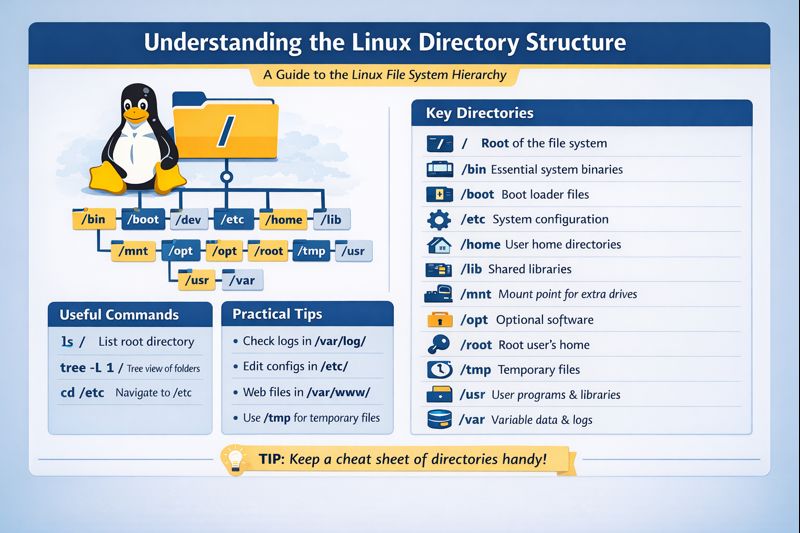
Filesystems and networking
The Linux kernel is modular, efficient, and continuously refined by a global community of developers and engineers.
This design allows Linux to adapt to almost any environment, from low-power embedded devices to massive multi-core servers handling millions of requests per second.
The Command Line: Precision Over Convenience
Linux does not hide complexity—it exposes it.
The command line interface is one of Linux’s most powerful features. It allows administrators and engineers to:
Automate repetitive tasks
Manage systems remotely
Script complex workflows
Diagnose problems with precision
With a single terminal, an administrator can configure, monitor, and control thousands of systems across data centers and cloud regions.
This is not about nostalgia or preference—it is about efficiency and scale.
Designed to Scale in Every Direction
Linux is remarkably flexible.
It runs comfortably on:
Tiny embedded boards with minimal memory
Smartphones and consumer electronics
Enterprise servers
Cloud platforms
High-performance computing clusters
This scalability is possible because Linux can be stripped down to essentials or expanded to handle extreme workloads.
Few operating systems can claim such a wide operational range.
Security Is Part of the Architecture
Linux security is not bolted on—it is fundamental to its design.
Key principles include:
Strong user and permission models
Process isolation
Minimal default services
Rapid patch availability
Because Linux environments vary widely, large-scale attacks are harder to generalize. Combined with transparency and community review, this makes Linux a resilient platform for secure systems.
Linux as a Professional Skill
Learning Linux is not just about using an operating system—it is about understanding how systems actually work.
Linux teaches:
Process and memory management
Networking fundamentals
Storage and filesystems
Automation and scripting
Troubleshooting at a system level
This is why Linux expertise is foundational for careers in:
System administration
Cloud engineering
DevOps
Cybersecurity
Site reliability engineering
Linux knowledge compounds over time.
Conclusion: Why Linux Is the Real Operating System
Linux does not try to impress users with appearances.
It focuses on correctness, reliability, and control.
It runs where failure is expensive.
It operates where scale is unavoidable.
It succeeds where visibility is optional but stability is mandatory.
Linux is not just another operating system.
Linux is the real operating system—quietly powering the world.